
Liner Notes: TetherGeist
Astral Platforming


This month, May, was TetherGeist month, and it was an overall positive experience for us, with the developers intelligently layering/designing on top of what felt like a foundation clearly inspired by Celeste (very clearly), Super Meat Boy and other precision platformers, as well as adjacent-genre platformers like Ori and the Blind Forrest.
Check out the full podcast here.
Accessibility/Adjustment
At about the seventeen minutes or so into the podcast, we realize neither of us took a careful look at the accessibility features — or menus — in TetherGeist. So I wanted to take a moment to investigate that in-game.
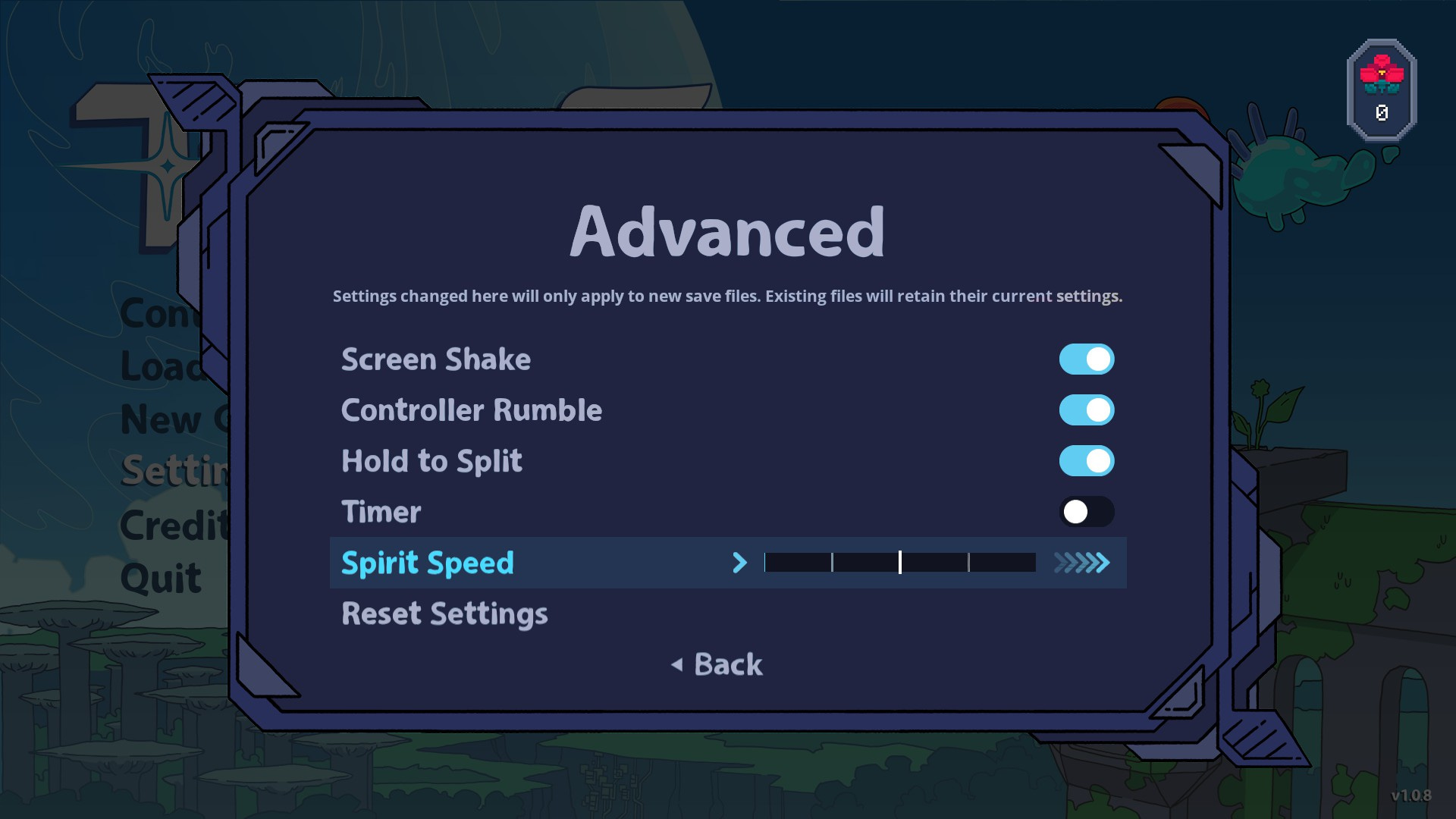
Looks like the accessibility features are limited to some changes to controls at the moment or fine tune a timing window: you can change the buttons/sequence used to astral project to not being “hold” as well as lower/raise the spirit speed.
To be fair, it’s not entirely clear to me that this is accessibility (as in raising or lowering the speed of how fast gravity makes you fall in “spirit” mode when you’re astral projecting), but I assumed this was the case and tried it in-game. Normally it’s set to two bars filled in (halfway). However, when I did try it, it didn’t seem to help me or provide a lot more time by lowering the Spirit Speed, so either the adjustment is quite fine or granular, or it adjusts something else in the game. (Also I am slightly out of practice, which doesn’t help for comparison, to be fair.)
*TLDR: take a look in the advanced settings and see if anything there makes sense for you. This does not seem to be as extensive as the features offered by Celeste, for example.
*I’ll update this post as/when I learn more.
Speed Runs
There are runs at any percentage of completion that are approaching 1 hour (1 hour eight minutes so far), which as usual seems unreal to me: https://www.speedrun.com/TetherGeist.
And this is a speed run from YouTube user nicoofthebasement which is a bit longer, but still impressive early into Teth erGeist’s shelf life as a game for runners (which we expect it certainly will be, given the precision-platforming and other things baked in):
Sales
Starting at minute twenty-five or so of the podcast, following up on sales discussion: Kick-started at first, with 500 backers, with 100 players at peak on Steam (without other revenue sources included), indicates a degree of success, but not conclusive ideas of what this has sold so far: https://www.kickstarter.com/projects/oandcogames/tethergeist
Documenting the Development of Games:
Indie Game: The Movie
Overly dramatized and not enough focus on how the games were made? Perhaps. But I don’t remember so well. I know there’s been drama among a few of these developers in terms of their subsequent projects as well as inter-team drama since, but mainly we just brought it up briefly, so I wanted to at least link a trailer here:
No Clip
More modern and ongoing example of people taking the documentary process seriously in relation to games and their development. Check out the No Clip channel for a ton more.
Game Developer’s Conference (GDC) Talks
And then perennial classic, the Game Developer’s Conferences, offers so much in terms of developers speaking directly to an audience (of developers and the public) about their games. Thankfully, they record these things.
Pocky and Rocky Reshrined Prologue:
Developer website: https://www.winning-ent.co.jp/english/
Just to clear up some of the talk about the developer of Pocky and Rocky Reshrined. They are not (only) former Natsume developers, but more like Natsume itself, merging with Atari at some point, then becoming Winning Entertainment Inc.
Check out our podcast on Pocky and Rocky Reshrined/Original at the end of June for more about that and their studio’s legacy of retouching/remastering their games.
Thanks for listening and reading!
.